
















RC paper is plastic coated and develops, rinses and dries quickly, which suits printing many pictures. Fibre-based paper takes longer to rinse and dry but has a heavier surface. Variable contrast paper is controlled with filters, so you only need one kind of paper. The surface is a matter of taste, from glossy to matt.
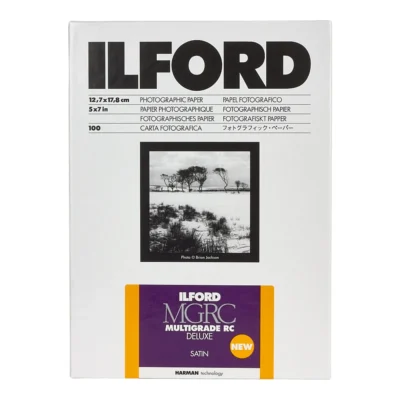


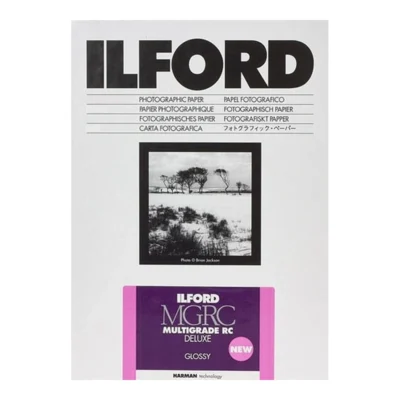
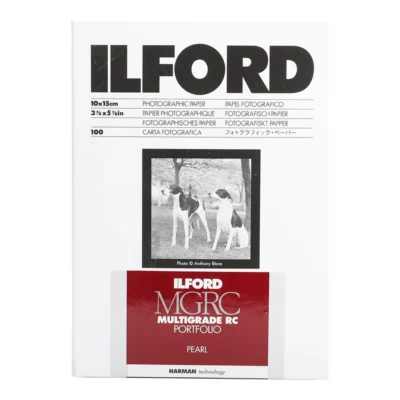
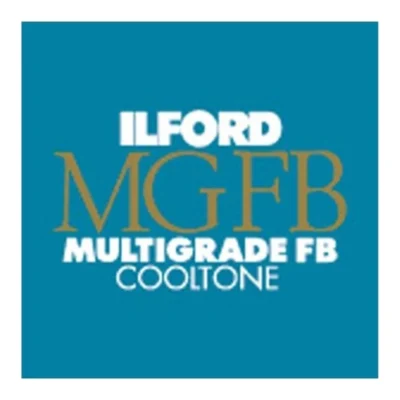
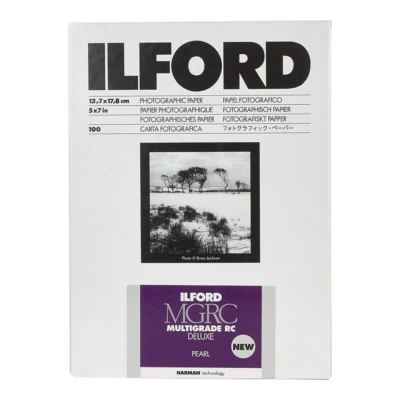


All the photo paper here is black and white, light-sensitive paper for the darkroom, almost all of it from Ilford. It is exposed under an enlarger or as a contact print and developed in chemistry. It will not work in an inkjet printer. If you are after paper for a printer or an instant camera, that lives in other categories.
Contrast grades and Multigrade filters
Ilford's Multigrade papers carry a blend of emulsions that respond differently to green and blue light. With filters in the enlarger you set contrast from grade 00, the softest, up to 5, the hardest, usually in half steps. Without a filter the paper lands at roughly grade 2.
Start with a test strip at grade 2 or 2.5 and look at the darkest and lightest areas. If the shadows look grey, go up a grade. If detail disappears from the sky, go down. A normally developed negative usually prints somewhere between 2 and 3.
With Ilford's filters, grades 00 to 3.5 need the same exposure time. Grades 4 to 5 need about double. That makes it easy to change grade without starting over.
You can also expose one print through two filters, a soft and a hard grade. This is called split-grade printing and lets you handle shadows and highlights separately.
RC paper or fibre paper
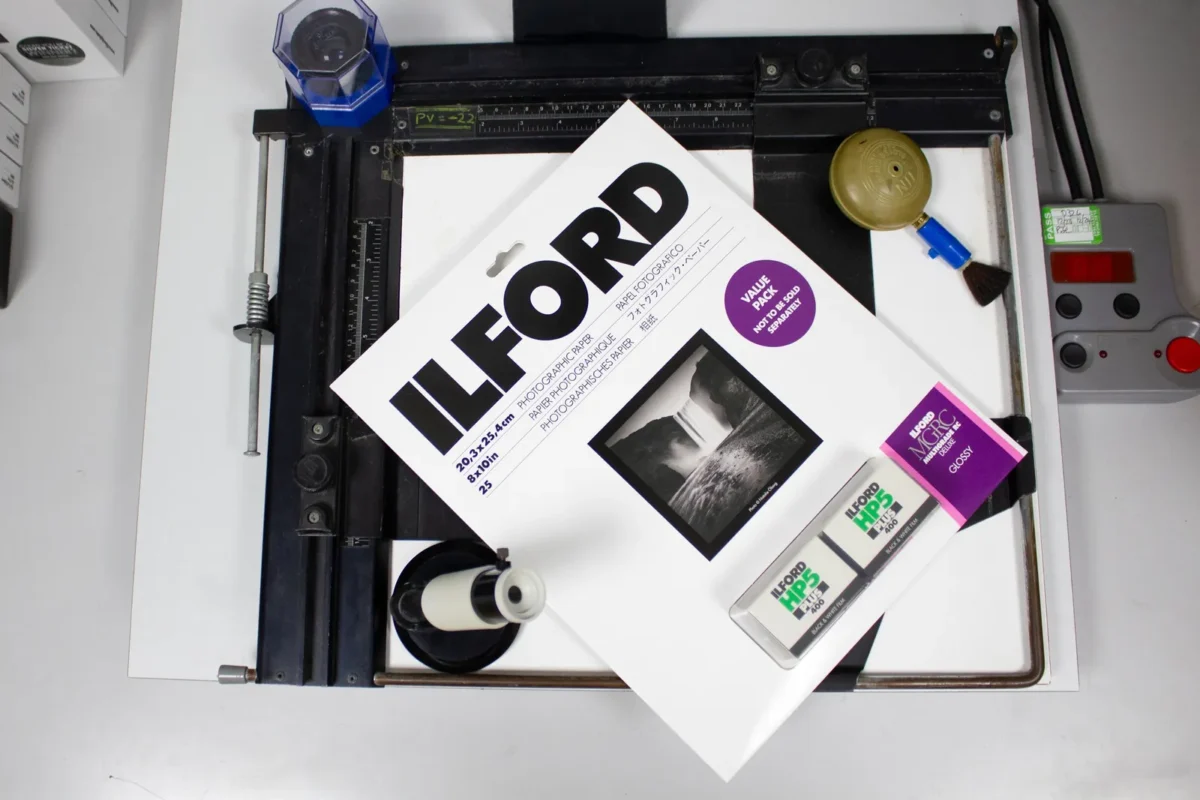
This is the biggest choice. You can see the difference in the print, and you feel it even more in the work.
| RC paper | Fibre paper | |
|---|---|---|
| Build | Paper base between plastic layers | Baryta-coated paper, no plastic |
| Washing | A few minutes | Up to an hour, less with a washing aid |
| Drying | Dries flat in a short time | Curls, needs pressing or drying on screens |
| Best for | Test prints, work prints, your first years in the darkroom | Exhibition, archive, toning |
We think RC is the paper to learn on. It is forgiving and quick, and you see the result the same evening. Once you have a picture you want to frame, fibre is worth the trouble. The surface has a depth that is hard to get from RC, and the paper takes toning and long storage better.
Surfaces and what the codes mean
Ilford marks its surfaces with short codes. On RC paper 1M means glossy, 44M pearl and 25M satin. On fibre paper 1K is glossy, 24K semi-matt and 5K matt. Matt cotton fibre paper such as Ilford's Art 300 looks like watercolour paper and suits portraits and soft subjects.
Glossy gives the deepest blacks and the most detail. Pearl and satin have a slight texture, reflect less and are easier to show under lamps. Matt surfaces soften the blacks but feel warm and calm.
Neutral, warm or cool tone
Image tone varies more than many expect. A neutral paper gives clean black and white. Warmtone has a cream base and a warm black that leans brown. Cooltone gives a blue-black on a bright white base.
Developer and toner also shape the tone. A warm-tone paper reacts clearly to selenium toner, while neutral papers mostly gain deeper blacks. If you want to work with toning, start with a warm-tone fibre paper.
Sizes, sheets and rolls
The paper comes in sheets from about postcard size up to 50x61 cm, in packs from ten sheets upwards. Rolls are used for very large prints and in machines. A small pack in the right surface and size is a good way to try before buying a hundred sheets.
For contact sheets, 8x10 inch paper is enough. A whole 35 mm roll, cut into strips of six, fits on one sheet under a piece of glass. The contact sheet becomes your map of the roll, and it is where you pick the frames worth enlarging. Keep the sheets together with the negatives.
Ilford also makes direct positive paper. It goes straight into the camera, a pinhole camera for instance, and gives a finished positive with no negative. It is very slow, so exposures are long.
Handling and storing paper
Open the pack only under a safelight. Black and white paper tolerates red or amber safelight at the right distance, but not ordinary room light. Close the inner black bag and the box before you switch on the ceiling light; most people make that mistake once.
Keep paper cool and dry and away from chemicals. Old paper can show grey fog in the whites. If you are unsure about an older pack, develop an unexposed strip and look at it.
Frequently asked questions about photo paper
Which black and white photo paper should I start with?
A variable-contrast RC paper, such as Ilford Multigrade RC Deluxe, is the easiest place to start. It washes and dries fast and contrast is set with filters. Choose glossy or pearl to taste.
Can I print on black and white photo paper in a normal printer?
No. Black and white photo paper is light-sensitive, exposed in the darkroom and then developed in chemistry. It is ruined if you open the pack in normal light.
What do 1M, 44M and 1K mean on Ilford paper?
They are Ilford's surface codes. M stands for RC paper and K for fibre paper. 1M is glossy RC, 44M pearl and 25M satin, while 1K is glossy fibre and 5K matt fibre.
Do I need filters for Multigrade paper?
Without a filter Multigrade gives about grade 2, which works for many negatives. With filters you can set contrast from 00 to 5. They go in the enlarger's filter drawer or below the lens.
What safelight is safe for photo paper?
Black and white paper tolerates red or amber safelight at the recommended distance. Do not leave paper out longer than needed, even under the safelight. Normal room light ruins it at once.