
















UV filter, protective filter or polariser?
Three round filters that screw onto the lens and look almost the same in the box. Yet they do completely different jobs. A UV filter and a clear protective filter are there to protect the front element and should ideally not show in the picture at all. A polariser is a tool: it removes reflections, deepens the sky and cuts through haze.
The difference in short
Protection or effect. That is really the whole choice. UV and protective filters pass almost all the light and leave colours alone, so the picture is much the same with or without one. A polariser deliberately removes part of the light, and you decide how much by rotating it. The table shows six filters from our categories UV filters, protective filters and polarising filters, cheapest first.
 NiSi Filter UV SMC L395 | 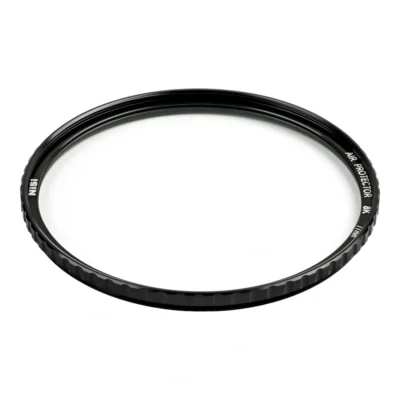 NiSi Filter AIR Protector | 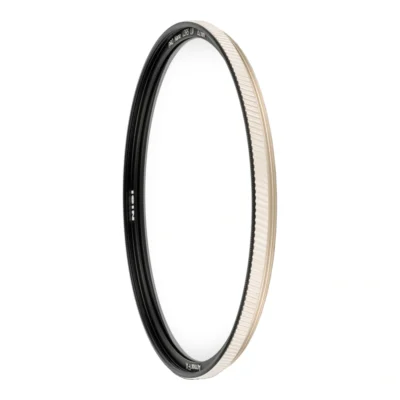 NiSi Filter UV Armor FX Pro Nano L395 |  NiSi Filter Circular Polarizer True Color CPL Pro Nano |  NiSi Filter Circular Polarizer True Color CPL Pro Nano Brass Frame | 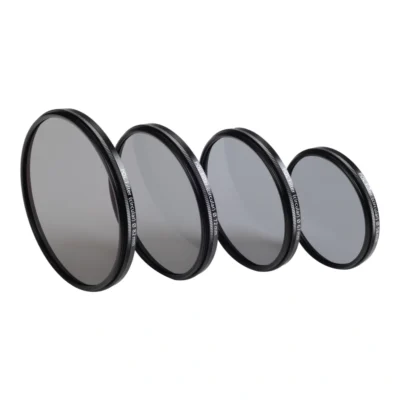 Zeiss T* Polarizing Filter Circular | |
|---|---|---|---|---|---|---|
| Why choose it | You want cheap protection with 16 coating layers | You want clear protection with 99.8 % transmission | You shoot where the filter may take a knock | You want polarisation without a warm tint | You want a brass frame and a removable knob | You have Zeiss lenses and want T* coating |
| Filter diameter | 37-95 mm | 40-105 mm | 39-95 mm | 43-105 mm | 40.5-105 mm | 49-95 mm |
| Filter type | UV | Protection filter | Protection filter, UV | Circular polariser | Circular polariser | Circular polariser |
| Manufacturer | NiSi | NiSi | NiSi | NiSi | NiSi | ZEISS |
| Price | Price range: 199 kr through 1,149 krSee the product | Price range: 419 kr through 1,399 krSee the product | Price range: 599 kr through 1,599 krSee the product | Price range: 699 kr through 2,299 krSee the product | Price range: 799 kr through 2,599 krSee the product | Price range: 1,349 kr through 7,499 krSee the product |
UV filters on a digital camera
In the film days the UV filter had a clear purpose. Film is sensitive to ultraviolet light, and in the mountains or by the sea it could add a bluish haze. A digital sensor sits behind its own filter stack that already stops most UV and IR light. On today’s cameras a UV filter therefore hardly shows in the picture. What remains is protection.
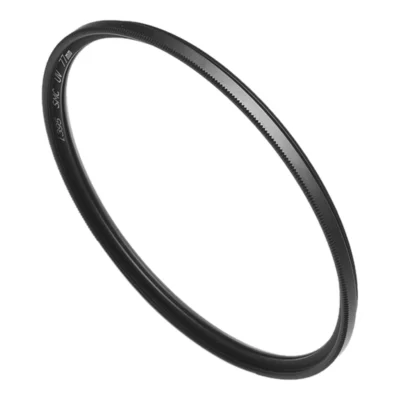
The NiSi UV SMC L395 blocks UV light below 395 nm and has 16 layers of anti-reflection coating spread over both sides of the glass. Transmission is 98.3 % and the frame only 3 mm. A cheap way to keep dust, fingers and spray off the front element, in sizes from 37 to 95 mm.
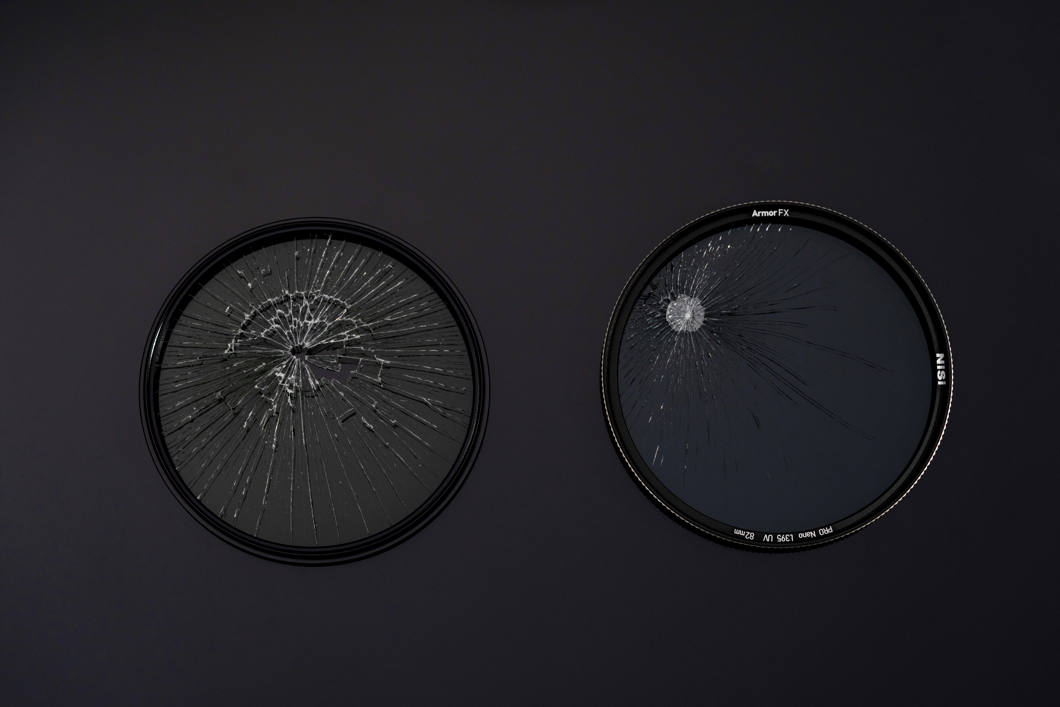
The NiSi Armor FX Pro Nano L395 is a UV filter too, but built with protection first. The glass is laminated like a car windscreen. After a hard knock it cracks without falling apart into loose shards that can scratch the front element. The design comes from NiSi’s explosion-proof cinema filters. Armor FX passes 99.3 % of the light, has nano coating on both sides and a knurled brass frame of 3.9 mm.
Clear protective filters: glass you should not notice
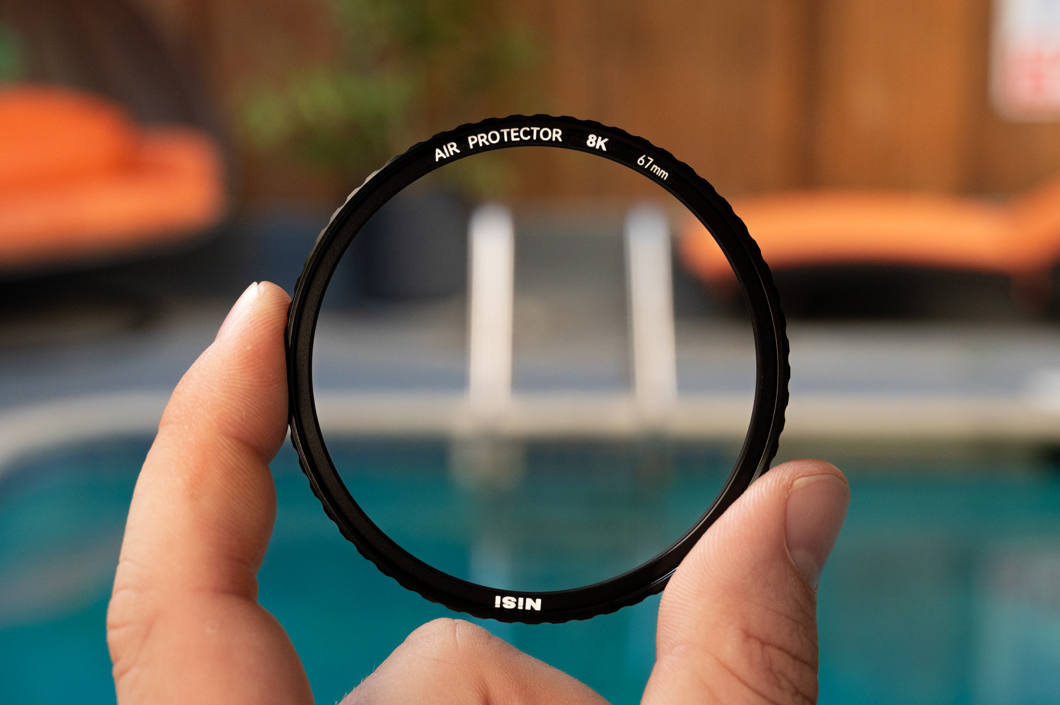
A protective filter, often called clear or protector, is clear optical glass without a UV cut. The job is the same as a UV filter on a digital camera: take the knock, the scratch or the salt spray instead of the lens. Since the difference between the two in the picture is so small on a modern sensor, choose by glass and coating, not by what the box says.
The NiSi AIR Protector passes 99.8 % of the light according to NiSi. The glass is so-called water-white, an extra clear optical glass with a neutral colour balance. The coating has 48 layers, 24 on each side, and repels water and grease. The frame is thin aluminium with a knurled edge. It comes in sizes from 40 up to 105 mm.
Polarisers: the only one of the three that changes the picture
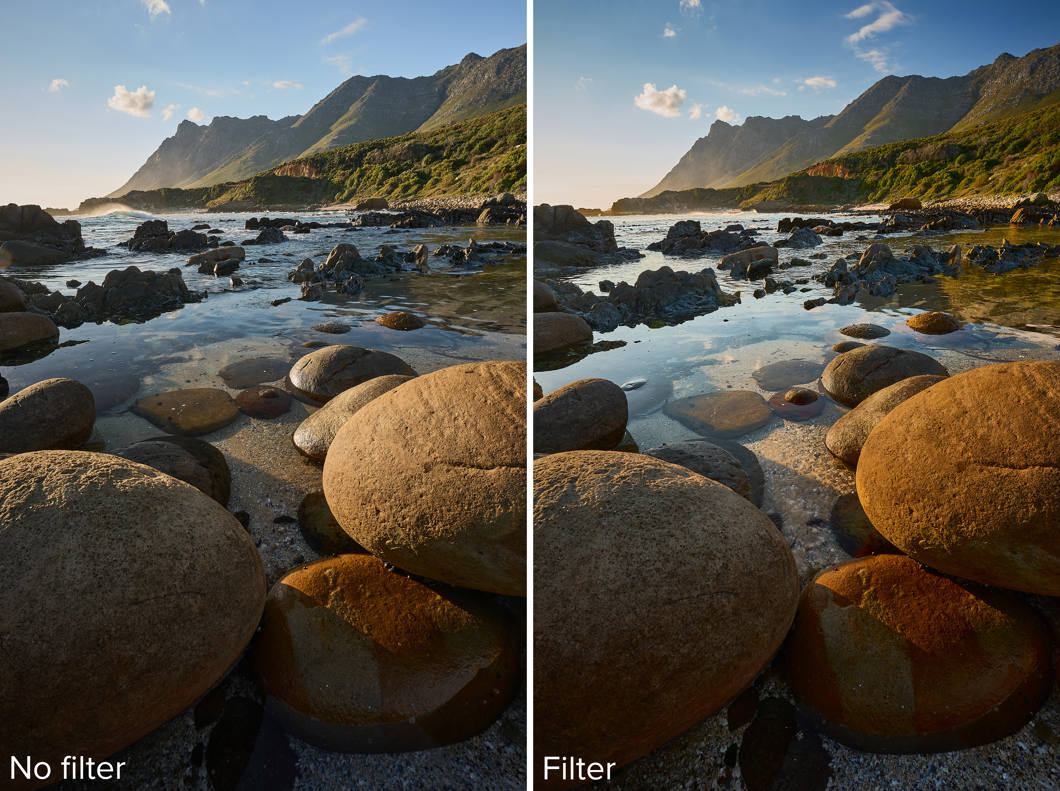
Light that bounces off water, glass, leaves or glossy paint becomes partly polarised. A polariser only passes light that vibrates in one direction, and as you rotate it you can switch off much of the reflected glare. The same principle darkens a blue sky, because skylight is polarised too, and reduces the haze towards the horizon. Colours that sat under a white sheen become saturated again.
The effect is strongest when you shoot at roughly 90 degrees to the sun. With the sun straight behind or straight in front of you almost nothing happens. On a very wide lens the frame holds so much sky that the effect turns uneven, with a dark band on one side and lighter sky on the other. Turn the filter back a little then, or take it off.
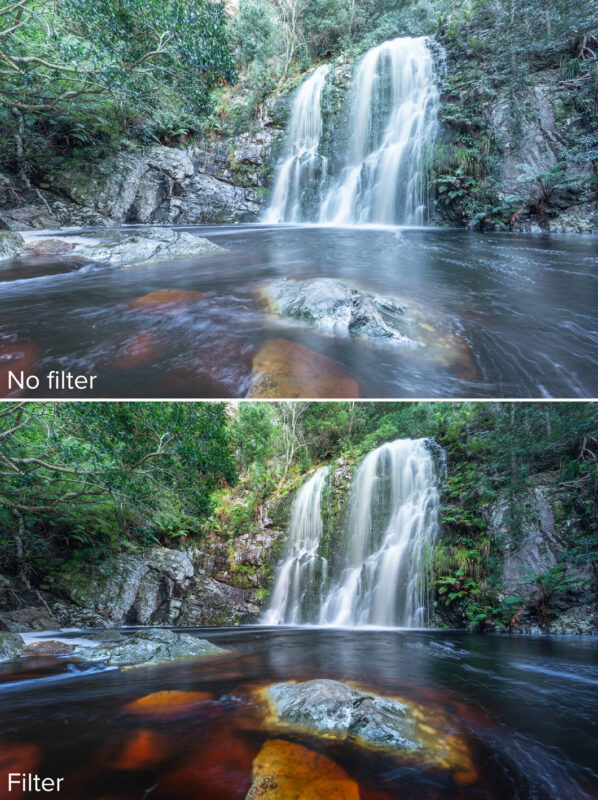
Reflections in water and glass
Water shows the difference most clearly. Without a filter the surface mirrors the sky. With the filter turned right the mirror image disappears and you see the stones on the bottom. The same goes for shop windows and car windows. Bare metal is the exception: those reflections cannot be removed with a polariser.
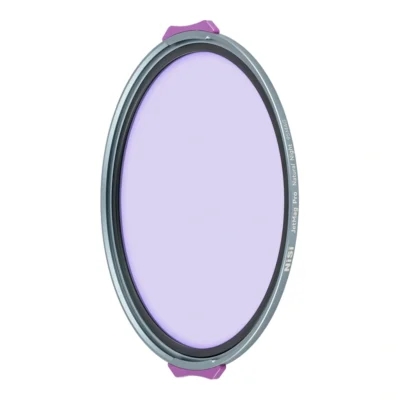
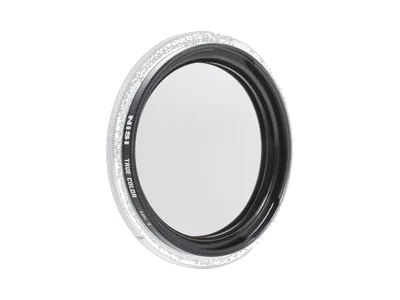
The NiSi True Color CPL Pro Nano uses a polarising film that, according to NiSi, avoids the warm, yellowish tint many polarisers give. It has nano coating on both sides and a two-tone ring of 4.9 mm.
The True Color CPL Pro Nano with brass frame has the same True Color film but a precision-milled brass frame with deep knurling. You screw the included knob on when the filter needs turning and off when you want a low profile.
Light loss and rotating the filter
A polariser always costs light. Zeiss states 1.5 to 2 stops for its Zeiss T* Polarizing Filter Circular, and that is about where polarisers tend to land. The camera compensates by itself, but at dusk or indoors it means a slower shutter speed or a higher ISO. Take the filter off when you do not need the effect. The Zeiss filter has T* coating and can be used with a lens hood.
The filter sits in a ring that turns freely. You rotate it while looking through the viewfinder or at the screen and stop where the effect looks right. Switch from landscape to portrait orientation and the angle changes, so you turn it again.
Choose a circular polariser, CPL. A linear one can upset autofocus and metering on cameras with a mirror, which is why round screw-in filters for normal lenses are practically always circular. Linear polarisers are mostly found as square filters for filter holders and as cinema filters.
Coating, flare and price
Every glass surface reflects a little light. A filter adds two surfaces in front of the lens, and against the light or with bright lamps in the frame light can bounce between the filter and the front element. The result is flare, ghosting and lower contrast. Multi-coating, several thin anti-reflection layers, is what keeps those reflections down. NiSi states 0.5 % reflection for the SMC L395 with its 16 layers. The AIR Protector has 48 layers and reaches 99.8 % transmission.
The nano coating on the more expensive filters is an outer layer that makes water and grease bead up. Fingerprints and raindrops wipe off more easily. Cheap uncoated glass is the wrong place to save money in front of an expensive lens, because backlight is where the contrast goes.
The right size and step-up rings
The filter size is the diameter of the thread at the front of the lens, in millimetres. It is almost always marked on the lens, after the Ø sign near the front element, and often on the inside of the lens cap as well.
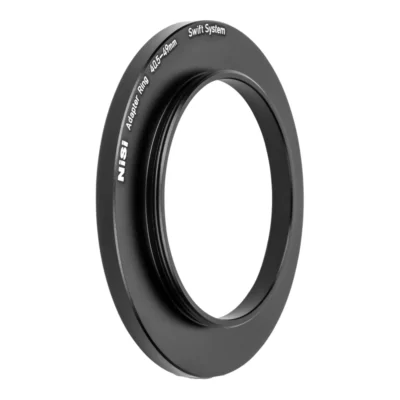
If you have several lenses with different threads you do not need a filter for each. Buy the filter in the largest size and put a step-up ring on the smaller lenses, for example from 67 to 77 mm. The other way round works badly: a filter that is too small on a larger lens shows as dark corners. The lens cap no longer fits either while the step-up ring is on. For a protective filter that stays on all the time a step-up ring is therefore rarely worth it. For a polariser that goes on now and then it is a good way to save money.
Stacking filters
A UV filter and a polariser on the same lens works, but each filter adds two glass surfaces and a few millimetres of frame. On a wide angle the frames can start to show as dark corners, vignetting. That is why the makers care about thin frames: the SMC L395 has 3 mm, Armor FX 3.9 mm and True Color CPL Pro Nano 4.9 mm. NiSi promises no vignetting with Armor FX down to 14 mm on full frame. That figure applies to the filter on its own.
The simplest habit is to unscrew the protective filter when the polariser goes on. That gives you two fewer glass surfaces against the light and no extra frame on the wide angle. Both the SMC L395 and Armor FX have a front thread, so you can stack them when needed.
Which one should you buy?
If the filter is only there to protect, a UV filter or a clear protective filter is enough. On a digital camera they do the same job. The SMC L395 costs the least and does fine on a lens that mainly needs protecting. For a sharp and expensive lens the AIR Protector is a better choice, with the highest transmission and the most coating layers of the three protective filters.
If you shoot in stands, at the race track, on building sites or in rough terrain where the camera takes knocks, Armor FX is worth the extra money. Shards from an ordinary filter can scratch the front element, and the laminated glass holds together.
If you want to change the picture itself you need a polariser, and no protective filter can replace it. The True Color CPL Pro Nano is the basic choice for landscapes and travel. The brass-frame version has deeper knurling and the knob. The Zeiss filter suits you if you have Zeiss lenses and want the T* coating, but it works on other brands too.
A common set-up is both: a thin protective filter that stays on all the time and a polariser in your pocket.
Frequently asked questions
Does a UV filter reduce image quality?
A filter with good multi-coating rarely shows in the picture. The difference shows mainly against the light, where cheap uncoated glass can cause flare and lower contrast. If you see ghosting with the sun or bright lamps in the frame, you can take the filter off.
Do I need a UV filter on a digital camera?
Not for the picture. The sensor has its own filter that stops most UV light. As protection for the front element a UV filter does the same job as a clear protective filter.
Can the polariser stay on all the time?
It can, but it costs light (Zeiss states 1.5 to 2 stops for its filter) and the effect changes as you turn the camera. As a filter that stays on, a clear protective filter is better.
How do I find the filter size of my lens?
Look for the Ø sign followed by a number on the front of the lens or on the inside of the lens cap. The number is the thread diameter in millimetres, and that is the size to choose.
Why should the polariser be circular?
A linear polariser can upset autofocus and metering on cameras with a mirror. A circular one works on every camera and gives the same effect in the picture.
Products in this article
More products are in the category uv filters.