








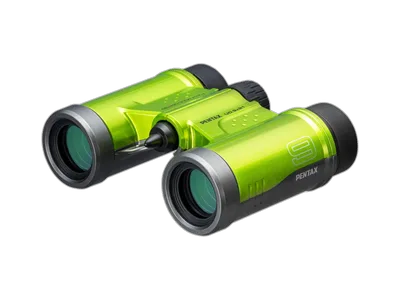








At sea, low magnification gives a steadier image even though the boat is moving, and a large objective diameter gives light at dusk. Marine binoculars should be waterproof and ideally float if dropped overboard. Models with a built-in compass show the bearing in the field of view.
Read more about marine binoculars
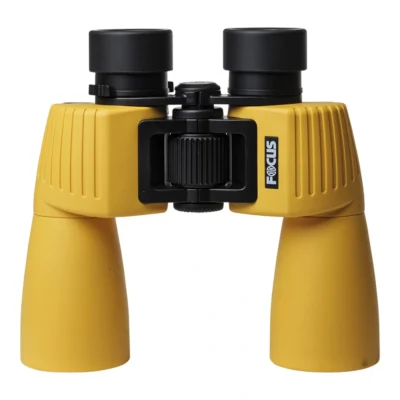


Marine binoculars are built to be used on something that moves, in wind, spray and poor light. They need to find a mark, a buoy or another boat quickly and show it steadily. That is why marine binoculars look much the same whoever makes them: big objectives, low magnification, a rubber-armoured body and often a compass in the view.
Why nearly all marine binoculars are 7x50
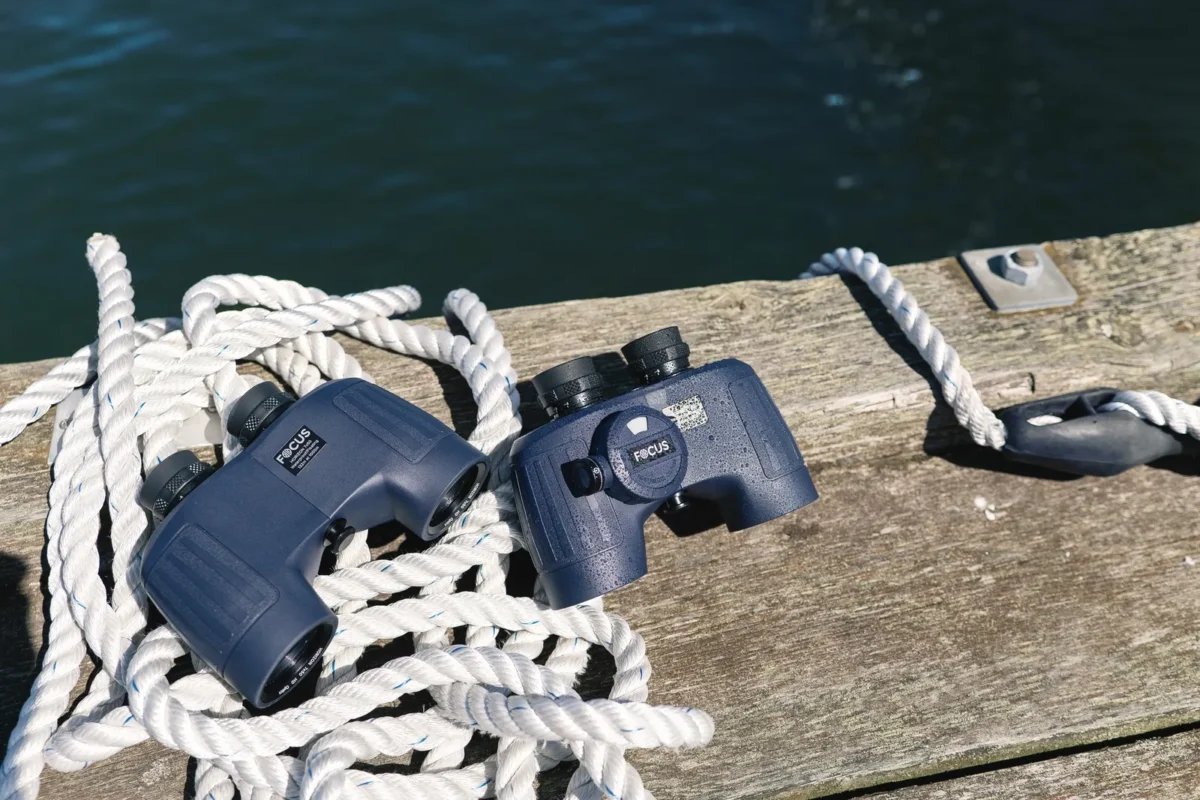
Seven times is about as much magnification as you can hold steady on a rolling boat. At 10x the image jumps so much in a seaway that you lose what you are looking at. Lower power also gives a wide field, which makes it easier to find a sea mark among the waves.
The 50 mm objective gives an exit pupil of just over 7 mm, as large as the eye's pupil in the dark. That means two things. The image is as bright as it can be at dusk and at night, and it does not matter if the binoculars move a little in front of your eye. You do not lose the view because the boat is rocking.
Nearly all marine binoculars use Porro prisms. The design handles big objectives without getting expensive and gives good depth perception when judging distance to land.
Compass and range scale
A built-in compass shows at the bottom of the view while you look. You aim at an object and read the bearing directly, without taking your eyes off it. It is used to fix your position against known points on the chart and to see whether another boat is on a collision course. If the bearing to an approaching boat does not change, it is time to alter course.
The range scale is a graduated line in the view. If you know the height of an object, such as a lighthouse or a sea mark, you can read how many marks it covers and work out roughly how far away it is. The manual explains how to read the scale. It takes a few tries to learn, but it keeps working when the electronics do not.
If you do not need the compass, a pair without one is a little lighter and has a cleaner view.
Individual focus or centre wheel
Many marine binoculars have individual focus. You set each eyepiece once, and from then on everything from a few tens of metres outwards is sharp. At sea nearly everything is far away, so you rarely need to touch it again. It also makes the binoculars easier to seal against water.
A centre-focus pair switches faster between near and far. It suits binoculars that will also be used on land, where distances change all the time.
Water, salt and fogging
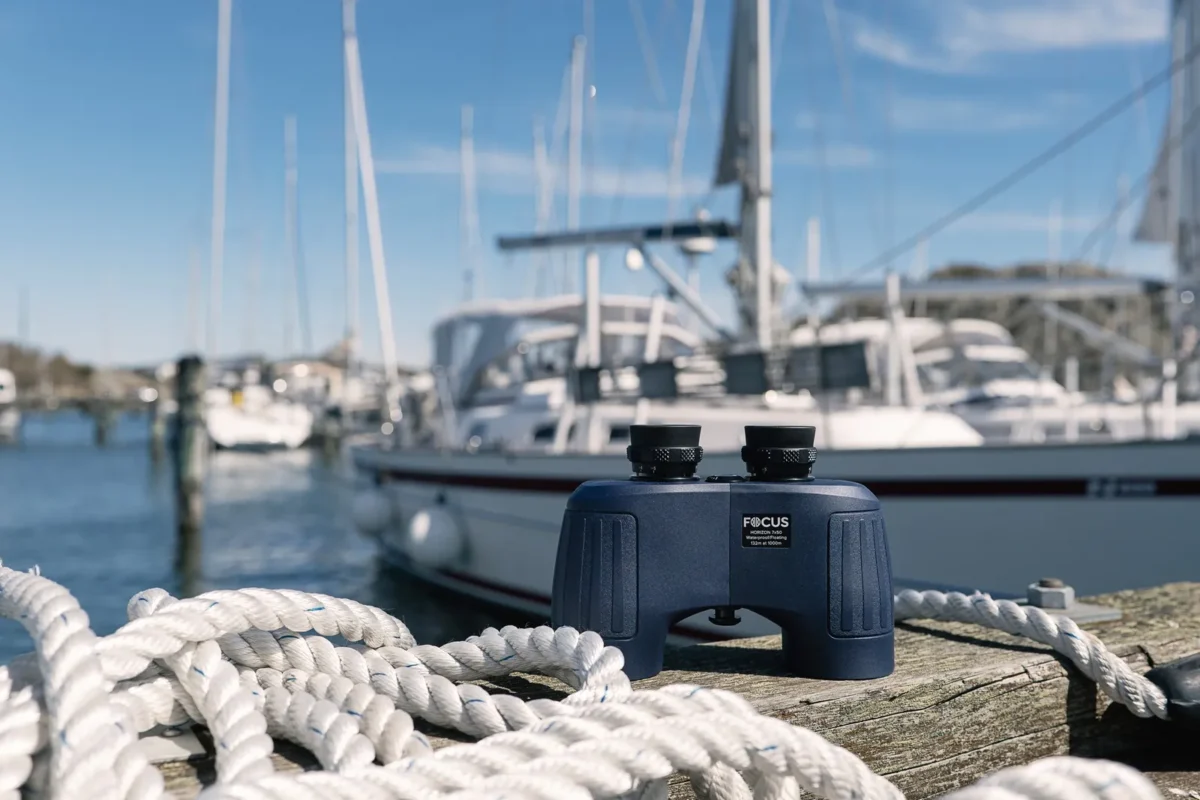
Marine binoculars should be waterproof, and several can be submerged a few metres. The sealing also keeps moisture out of the inside. Nitrogen-filled binoculars do not fog internally when you move from a cold cockpit into a warm cabin.
Not every 7x50 is built for the sea. Check that the pair really is waterproof. Rubber armour alone is not enough.
Rinse the binoculars in fresh water after a day of salt spray and let them dry outside the case. Salt that dries on the lenses scratches when you wipe it off. A floating strap keeps the binoculars afloat if they go overboard, and it costs little compared with a new pair.
Marine binoculars on land
What makes a 7x50 good at sea makes it good on land in poor light too. The big exit pupil gives a bright image at dusk and at night, and the low power makes it easy to hold still. Many people use one for stargazing, as the wide field shows star clusters and the Milky Way in a way a spotting scope cannot.
The downside is size and weight. As your only pair for hiking or birding, nature binoculars are usually the better choice.
Frequently asked questions about marine binoculars
Why are marine binoculars 7x50?
Seven times magnification can be held steady on a moving boat, and 50 mm objectives give an exit pupil of just over 7 mm. That means a bright image at dusk and you do not lose the view as the boat rocks.
What are marine binoculars with a compass?
They have a built-in compass that shows in the view. You can read the bearing to an object while looking at it, which is used for navigation and to judge whether another boat is on a collision course.
How does the range scale in binoculars work?
The scale is a set of graduated marks in the view. If you know how tall an object is, such as a lighthouse, you can work out roughly how far away it is from how many marks it covers. The manual explains how to read your binoculars' scale.
Do boat binoculars need to be waterproof?
Yes, for use at sea they should be waterproof and ideally nitrogen-filled so they do not fog inside. Rinse them in fresh water after salt spray.
Can you use marine binoculars on land?
Yes, a 7x50 is good at dusk, at night and for stargazing. It is heavier and bigger than nature binoculars, though, so there are better choices for hiking and birding.